District 4 House of Representatives Rutherford Vs Selmont
Who is the most powerful person in the United States? As commander-in-chief of the United States Armed Forces, the President is arguably recognized as the unmarried near powerful person in the U.S. The President is elected by the people through the Electoral College and a person may serve every bit President upwardly to ii four-yr term.
Presidents of the United states of america in Chronological Order
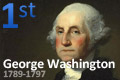 i. George Washington (April 30, 1789—March iv, 1797). No party. The 1st U.S. President. Washington served two terms. An American War General in the American Revolutionary War. As master of the executive branch and caput of the federal regime, the presidency is the highest political function in the The states by influence and recognition.
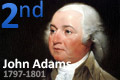 2. John Adams (March 4, 1797—March 4, 1801). Federalist. The second President of the Us was a man who resided in New England and was a prominent attorney and politician from Boston. Adams was extensively educated with Enlightenment ideas and republicanism. A key Founding Father of the U.S.
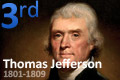 3. Thomas Jefferson (March iv, 1801—March 1809). Autonomous-Republican. The third President of the United States was i of the contributing writers of the Declaration of Independence. Equally a Founding Father, Jefferson wished that America would become an "Empire of Liberty," representing the ideals of republicanism.
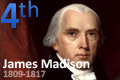 four. James Madison (March 4, 1809—March 4, 1817). Democratic-Republican. Madison is revered as the "Male parent of the Constitution" and the writer of the U.S. Neb of rights. The U.Southward. Constitution is considered the most important political certificate always written. It would go the model by which constitutions later written in other countries would follow.
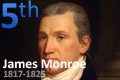 v. James Monroe (March four, 1817—March 4, 1825). Autonomous-Republican. The 5th President of the U.S. and the last who was a Founding Father. He would also be the last of presidents from the "Virginia dynasty." Monroe was well regarded for the Monroe Doctrine in 1823 which asserted that the U.Due south. would no longer permit European intervention in the Americas.
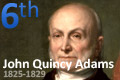 6. John Quincy Adams (March 4, 1825—March 4, 1829). Democratic-Republican; National Republican. John Quincy Adams was the son of John Adams and Abigail Adams. As an American diplomat he served both Senate and House of Representatives. Adams' presidency was not almost as effective as the 17 years he later served as an elected U.S. Representative of Massachusetts. He and his married woman, Abigail, were both strongly opposed to slavery during their fourth dimension.
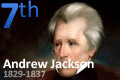 7. Andrew Jackson (March 4, 1829—March 4, 1837). Democratic. Jackson was an regular army full general and politician before becoming a U.S. President. During the Revolutionary State of war, when he was 13, he received a sword cut for refusing to make clean a British officer's shoes. Jackson was as well known every bit "One-time Hickory" for his aggressive character. Jackson's policies established what was known every bit "Jacksonian Democracy" which opposed authorities monopoly. Despite beingness a protector of pop republic, he also owned slaves and supported Slavery and Indian removal.
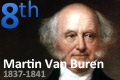 8. Martin Van Buren (March 4, 1837—March 4, 1841). Democratic. Van Buren was the start President born as a United states denizen since the American Revolution. For a while he was Andrew Jackson'southward Secretary of Land and Vice President and was therefore an essential individual in the evolution of Jacksonian democracy. He was in office during an economic hardship, the Panic of 1837. For this he was often blamed and was named "Martin Van Ruin" by political opponents.
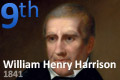 9. William Henry Harrison (March 4, 1841—April 4, 1841). Whig. Harrison was the first President to die in role. He died after 31 days in office due to pneumonia, making his tenure the briefest in the U.S. presidential history. This result led to many questions about presidential succession that was not answered by the Constitution until the inclusion of the 25th Amendment.
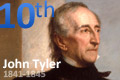 10. John Tyler (April 4, 1841—March iv, 1845). Whig, then no party. After the passing of President William Henry Harrison, John Tyler, his Vice President took the oath. This succession would effigy hereafter successions and became scripted in the 25th amendment. Tyler had been a Democratic-Republican before joining Harrison'southward entrada. While in office he opposed and vetoed many Whig party proposals, resulting in the resignation of most of his cabinet and him being expelled from his party.
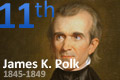 xi. James K. Polk (March 4, 1845—March four, 1849). Democratic. Polk had served every bit Speaker of the Business firm from 1835 to 1839 and Governor of Tennessee from 1839 to 1841 before defeating Henry Clay for president in 1844 with his promise to annex Texas. He was likewise a prominent leader of Jacksonian Republic.
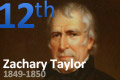 12. Zachary Taylor (March 4, 1849—July ix, 1850). Whig. Taylor was a career war machine officeholder before running as a Whig in 1848. He was also known equally "Old Rough and Ready," having served in the War of 1812, the Black Hawk War, and the 2nd Seminole War. His moderate view on slavery angered many Southerners. After xvi months into his term, Taylor died of gastroenteritis.
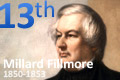 13. Millard Fillmore (July ix, 1850—March four, 1853). Whig. Fillmore was the concluding Whig to become a U.Due south. president. He causeless presidency after President Zachary Taylor's death, since he was vice president. During his presidency he supported keeping slavery out of lands acquired from the Mexican-American War as a ways to appease Southerners. He also supported and signed the Compromise of 1850 and the Fugitive Slave Act.
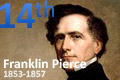 14. Franklin Pierce (March 4, 1853—March four, 1857). Democratic. Pierce was a Democrat who was a Northerner with Southern sympathies (a.k.a. a "doughface"). During his presidency he made many divisive choices that earned him a reputation of one of the worst presidents. He was abandoned past his political party and not nominated in 1856. During the Civil War he supported the Confederacy, further damaging his reputation.
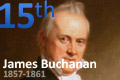 15. James Buchanan (March iv, 1857—March 4, 1861). Democratic. Buchanan was a popular state politician and attorney before his presidency. Throughout most of the presidential term before him, he was stationed in London while serving as Minister to the United kingdom. Because of this, he was non up-to-engagement on the crisis caused by the question of slavery. He spent a lot of his energy to maintain peace between the North and the Due south, but ultimately the Southern states declared secession.
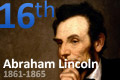 xvi. Abraham Lincoln (March four, 1861—April 15, 1865). Republican. In his entrada for president, Lincoln opposed the expansion of slavery. His victory led to the secessions of southern slave state, leading to the American Ceremonious War. Lincoln closely led the war effort, selecting highly skilled generals such equally Ulysses Due south. Grant. Lincoln was known to exist a very charismatic leader with great oratory skills. Scholars recognize him as i of the greatest U.Southward. presidents.
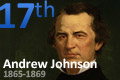 17. Andrew Johnson (April 15, 1865—March four, 1869). Autonomous. Andrew Johnson became president when President Lincoln was assassinated. As president in accuse of the Reconstruction, Johnson drafted conciliatory policies towards the Southward in a bustle to reincorporate former states of the Confederacy. His deportment made him unpopular with Radical Republicans. The Radicals of the House of Representatives impeached him in 1868 just the Senate acquitted him by one vote. He was the first president to go through an impeachment trial.
 18. Ulysses South. Grant (March four, 1869—March 4, 1877). Republican. The eighteenth president of the U.S. was an regular army general during the American Civil War. The Union Army was able to defeat the Confederate endeavour when Grant was appointed lieutenant general. As President, Grant supported civil rights for freed slaves and contributed to the revival of the Republican party in the South. He also fought KKK violence. However, despite all this, his assistants tolerated abuse and bribery. He was very unpopular when he left office.
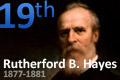 xix. Rutherford B. Hayes (March 4, 1877—March 4, 1881). Republican. President Rutherford B. Hayes was voted in during the close of the Reconstruction and when the 2nd Industrial Revolution occurred in the U.S. Prior to his presidential service, Hayes served the Union Ground forces during the Civil War. He believed in a meritocratic regime and racial equality.
 twenty. James A. Garfield (March iv, 1881—September 19, 1881). Republican. Earlier becoming president Garfield served as a Representative for nine terms. Garfield advocated agricultural engineering science, civil rights for African Americans, a bi-metal monetary system, and an educated electorate. Garfield was assassinated subsequently 200 days of being in office.
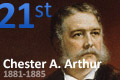 21. Chester A. Arthur (September 19, 1881—March iv, 1885). Republican. Arthur became president subsequently the assassination of President James A. Garfield. Arthur grew up in New York and afterward practice police there. During the Civil War he was appointed to the quartermaster department while becoming brigadier full general. Despite being poor health, he was able to perform solidly while in office. He left office respected by political allies and foes alike.
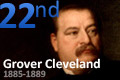 22. Grover Cleveland (March 4, 1885—March 4, 1889). Democratic. Cleveland was the only Autonomous candidate to win presidency during the era of Republican domination from 1860 to 1912. He was also the but president to serve ii terms non-consecutively. He was a leader among Bourbon Democrats who were opposed to inflation, subsidies, imperialism, Gratuitous Silvery, and loftier tariffs.
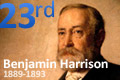 23. Benjamin Harrison (March 4, 1889—March iv, 1893). Republican. Benjamin Harrison was a grandson of sometime president William Henry Harrison, making him the simply president to be the grandson of another president. His legislation was responsible for the McKinley Tariff and the Sherman Antitrust Act every bit well as for federal spending to reached one billion dollars annually for the kickoff time.
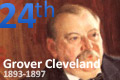 24. Grover Cleveland (March 4, 1893—March 4, 1897). Democratic. Meet a couple ranks above. Cleveland was the only president to be ranked twice, due to his non-sequent service as president.
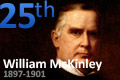 25. William McKinley (March four, 1897—September fourteen, 1901). Republican. In his elections McKinley fought fiercely for upholding the gilded standard and loftier tariffs. His leadership brought victory for the U.Due south. in 90 days in the Castilian American War. He is also highly regarded for forging a Republican coalition that dominated U.S. politics until the 1930s.
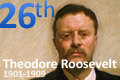 26. Theodore Roosevelt (September 14, 1901—March 4, 1909). Republican. As a soldier, explorer, hunter, naturalist, and writer, Theodore Roosevelt was known for his cowboy image and robust masculinity. Before presidency he served offices at the federal, land, and municipal levels of government. Roosevelt became president when President William McKinley was assassinated. During his administration he tried to mobilize the Republican Party towards ideas of Progressivism. He won his outset Presidential election afterward, which was technically his second term as President of the U.S.
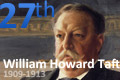 27. William Howard Taft (March 4, 1909—March four, 1913). Republican. William Howard Taft was the but U.Due south. President in history who also became a Chief Justice of the Supreme Courtroom. He was born into the wealthy Taft family. He graduated from Yale in 1878 and from Cincinnati Law School in 1880. He was elected as President in 1908.
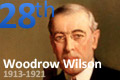 28. Woodrow Wilson (March 4, 1913—March 4, 1921). Democratic. Wilson was elected president as a Democrat in 1912. He was the but U.S. President to earn a Ph.D. degree. During his administration the U.Southward. entered World War I and renounced neutrality when Deutschland began unrestricted submarine warfare. He was barely reelected in 1916.
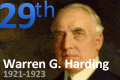 29. Warren G. Harding (March 4, 1921—August 2, 1923). Republican. Harding was a successful newspaper publisher before becoming president (this made him the outset). During his entrada he promised to restore the U.S. to "normalcy." President Harding often rewarded political allies and contributors with powerful positions with financial leverage. Scandals and corruption ran rampant nether his administration. Scholars and historians consistently regarded Harding as one of the worst Presidents. He died during a train end while on a return trip from Alaska to California.
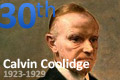 30. Calvin Coolidge (August 2, 1923—March 4, 1929). Republican. Calvin Coolidge succeeded President Warren G. Harding when the latter passed away while nonetheless in office. Coolidge restored the public's conviction of the White Business firm and its driblet because of the scandals from Harding'due south administration. Coolidge was highly pop when he left office and was elected to serve again in 1924 after finishing Harding's term.
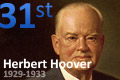 31. Herbert Hoover (March four, 1929—March 4, 1933). Republican. One of Hoover's strategies to garner votes was to entreatment to white Southerners and ignored civil rights. Hoover was a professional person mining engineer. His training and technical expertise led him to believe in the Efficiency Motion, which asserted that the economic system and government were inefficient and wasteful and could therefore be improved by skilful knowledge. Less than eight months in office Hoover had to face up the Great Depression. By the end of his term his administration had yet to find a solution to the economic disaster.
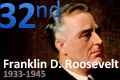 32. Franklin D. Roosevelt (March iv, 1933—April 12, 1945). Autonomous. A.one thousand.a. FDR. FDR is consistently regarded by scholars as the superlative 3 U.S. Presidents. He was the merely president to serve iii terms, after which an amendment was drafted to officially declare the two-term limit. During his time as president, FDR juggled with a great depression and a world state of war. Over the course of his presidency he drafted many projects which re-stimulated the economy and reduced unemployment from xx% to as low every bit two%.
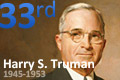 33. Harry S. Truman (April 12, 1945—January 20, 1953). Autonomous. Truman served as President Franklin D. Roosevelt'due south third vice president and succeeded him on Apr 12, 1945 when he died less than iii months of his 4th term. During his presidency Truman had to deal with many challenges in domestic affairs. He established the Truman Doctrine to contain communism and spoke out against racial discrimination in the armed forces.
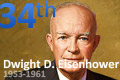 34. Dwight D. Eisenhower (January twenty, 1953—Jan 20, 1961). Republican. Before his service as the 34th U.South. President, Eisenhower was a five-star general in the U.S. Army. During WW2 he served every bit Supreme Commander of Allied forces with responsibility for leading the victorious invasion of France and Germany in 1944 to 1945. His focus as President was to reverse stop U.Southward. neutrality and challenge Communism and corruption. He drafted NASA to compete with the Soviet Union in the space race.
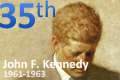 35. John F. Kennedy (Jan 20, 1961—Nov 22, 1963). Democratic. As well known as JFK. At age 43 Kennedy was the second youngest president e'er when elected, later on Theodore Roosevelt. JFK was the but president to have won a Pulitzer Prize and the only Catholic president. Events that happened during Kennedy's presidency included the building of the Berlin Wall, the Cuban missile crisis, the Bay of Pigs Invasion, the early Vietnam War, the Space Race, and the African American Civil Rights Motility.
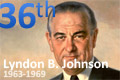 36. Lyndon B. Johnson (Nov 22, 1963—January 20, 1969). Democratic. President Lyndon Johnson was one in iv presidents to have served in all four federal offices of the U.S. government (President, Vice President, Representative, and Senator). He was well known for his domestic policies, including ceremonious rights, Medicaid, Medicare, Public Broadcasting, the "State of war on Poverty," educational aids, and environmental protection. Even so, his foreign strategy with the Vietnam War dragged his popularity.
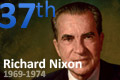 37. Richard Nixon (January twenty, 1969—Baronial 9, 1974). Republican. President Nixon was the only president to resign from office. His presidency involved improvement of relations with the People's Republic of China, the ending of U.Due south. involvement in the Vietnam War, and the achievement of détente with the Soviet Union. Nixon'due south 2nd term was riddled with controversy of the Watergate scandal.
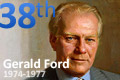 38. Gerald Ford (August nine, 1974—Jan twenty, 1977). Republican. Ford was assigned vice president when Spiro Agnew resigned during Richard Nixon's administration. When Nixon resigned, Ford became president. While in role Ford signed the Helsinki Accords, easing relations during the Cold State of war. Interest in Vietnam substantially ended non long afterwards he became president. The economic system was the worst since the Great Low while he was in office. He likewise granted a presidential pardon to President Richard Nixon for the Watergate scandal, which drew controversy towards his name.
 39. Jimmy Carter (Jan 20, 1977—January 20, 1981). Democratic. Carter was the 39th President of the U.South. and the but to receive a Nobel Peace Prize (in 2002) after leaving office. As president, he created 2 new cabinet departments: the Department of Teaching and the Department of Free energy. The end of his term saw the Iran hostage crunch, the 3 Mile Island nuclear blow, the invasion of Afghanistan by the Soviet, the 1979 energy crisis, and the 1980 eruption of Mount St. Helens.
 40. Ronald Reagan (January xx, 1981—January 20, 1989). Republican. Prior to becoming a politician Ronald Reagan had been a radio broadcaster and role player. He earned a Bachelor of Arts degree in folklore and economics. As president, Reagan implemented new economic policies that became known as "Reaganomics."
 41. George H. W. Bush (January twenty, 1989—January 20, 1993). Republican. Before becoming the 41st President of the U.S., George H. West. Bush served as the 43rd Vice President, an administrator, a congressman, and Director of Key Intelligence. He served as a U.S. Navy aviator during Globe War 2. After the war he attended and graduated from Yale in 1948. He went into the oil business and became a millionaire by age 40.
 42. Pecker Clinton (Jan twenty, 1993—January 20, 2001). Democratic. Clinton was elected into office at 46, making him the tertiary youngest president. He was the start president of the infant boomer generation. He graduated from Yale Law School. Clinton was involved in a scandal with a White House intern, which most got him impeached. Despite that, his work as president earned him the highest blessing rating of any president since World State of war Ii.
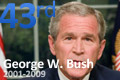 43. George W. Bush (January xx, 2001—January twenty, 2009). Republican. Bush graduated from Yale in 1968 and Harvard Business organisation School in 1975, working in oil businesses after. Bush advocated policies on wellness care, the economy, social security reform, and education. In 2005 Bush was criticized for his administration'south handling of Hurricane Katrina. With the combination of dissatisfaction with the Iraq State of war and the longest mail service-World War Ii recession in Dec 2007, Bush-league'south popularity declined sharply.
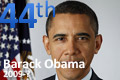 44. Barack Obama (January 20, 2009—Incumbent). Democratic. Current President Obama is the first African American U.S. president. He was previously a U.South. Senator from Illinois. He was born in Honolulu, Hawaii. He graduated from Columbia University and Harvard Police force School.
wunderlichwourethe.blogspot.com
Source: https://totallyhistory.com/us-history/us-presidents/
0 Response to "District 4 House of Representatives Rutherford Vs Selmont"
Post a Comment