Congressional Government Woodrow Wilson the House of Representatives
Would Woodrow Wilson recognize the Congress today as the kind of party regime he yearned for in his classic treatise, Congressional Regime: A Study in American Politics? Probably not, was the consensus of a group of current and erstwhile congressional staff members and expanse scholars participating in a roundtable discussion commemorating the 120th anniversary of Wilson's book and doctoral dissertation at Johns Hopkins Academy in 1885.
Wilson was enamored of the British parliamentary arrangement of unified party regime in which the legislative and executive were combined nether a single leader. American legislators, on the other hand, do not last long in the traces of party discipline or presidential authority; their constituencies and private inclinations ultimately triumph.
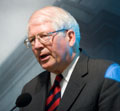 Congressman David Due east. Price (D-Northward.C.), who keynoted the roundtable, joked that the Republican takeover of Congress in the 1994 elections provided him with "an unsought two-yr sabbatical back at Duke Academy." But he rebounded ands was reelected in 1996 and is now serving his 9th term in Congress. Just prior to his defeat in 1994, Price delivered a lecture at the Wilson Heart on "Congressional Government Revisited," in which he assessed Wilson's work from the perspective of a majority party Democrat. Price said returning to Congress every bit minority party member who had been defeated equally an incumbent, has contradistinct his personal perspective and given him "some second thoughts near responsible party government." However, he added, "The 2nd thoughts do not bespeak a reversal: I continue to believe in the virtues of political party discipline in the House and to attempt to help achieve it on our side of the alley."
Only Cost was sharply critical of how House Republicans have wielded their majority powers: "Republicans have taken the consolidation of leadership control in the House and partisan unity in supporting a Republican administration far across what nosotros Democrats aspired to, much less achieved." In the process, Toll said, "GOP control took a harder edge in terms of tactics designed to eliminate dependence on, or participation past, Democrats, while keeping the narrow Republican bulk in line." Price cautioned that party government carries with it a need for balanced to be struck and excesses to be avoided involving "legitimate bug of fairness and institutional openness," the danger that a party authorities can "magnify the furnishings of irresponsibility and error if badly used," and that Congress still needs "a capacity for bipartisan besides as partisan capacity." Price said information technology was important "to temper party efficiency and subject area with processes that foster diverse input, due deliberation, and the building of consensus." Price saw 3 major changes in Congress since 1994: committees are in decline, deliberation is diminished, and considering Congress is deferring too much to the president today, and consequently information technology is failing to exercise its oversight responsibilities of the Executive Branch. In summary, Cost said, this era of "hyper-partisanship and its effects are "compelling and consequential" subjects for "mutual counsel, and it is time for our land'southward political leaders, scholars and citizens to accept heed."
 William F.Connelly, Jr.,, professor of political science at Washington and Lee University in Lexington, Virginia, drew a close comparing between Woodrow Wilson and former Speaker Newt Gingrich. Both were strong believers in party government and disliked committee authorities. Both "admired the parliamentary ideal and saw Congress equally central to our constitutional system" and viewed presidents as mere administrators. [Wilson would afterward modify his position on the potential for the president to lead both his party and the nation (Constitutional Government, 1908).] Both Wilson and Gingrich also viewed party government as a "competition of ideas" as opposed to a struggle among various special interests. Wilson was especially critical of the separation of powers organization mandated by the Constitution considering it made government ineffective and inefficient. Connelly added that what Wilson really despised were the checks and balances between the branches that made unified party governance impossible. Wilson did non recognize the inevitability of Madisonian pluralism, of interests fighting interests, thinking these defects could be overcome by parties which engaged in debates over lofty ideas most the national interest as opposed to bargaining over how to gratify the special interests.
Connelly concluded that parties are about both ideas and interests, and that over time our organization "oscillates betwixt presidential government and congressional regime," and inside the Congress, "betwixt party regime and committee government."
 Rochelle Dornatt, main-of-staff to Congressman Sam Farr (D-Calif.), and Lee Rawls, former primary-of-staff to Senate Majority Leader Nib Frist (R-Tenn.), led off the roundtable discussion with cursory remarks on the themes posed past Wilson'due south piece of work. Dornatt said information technology would be oversimplifying to concluded nosotros are either a authorities of committees or parties in Congress. "It's probably neither or both." But she did agree with Price that committees take been in decline and "are pretty irrelevant today." "The bulk party rules," she added, "but that does not interpret into governing." Citing responses to Hurricane Katrina and the lack of planning in Republic of iraq, she noted that "control of the government does non mean governing effectively." Moreover, "because a party is in control, it exerts bailiwick; merely that does non necessarily hateful unity," as recent cracks in unity over upkeep and other matters take revealed. Wilson feared "parochialism and individualism would run wild under commission government," Dornatt said, "but it is under the current party organisation that members are struggling to remain relevant and make a departure for their constituents."
  Rawls said Price's critique of the current party organization may well apply to the House, but "the Senate is quite different." It is slower, much more deliberative, and individual senators still matter. "Nosotros're like an former, water-logged rowboat. We don't sink; we just keep moving forth slowly."
One of the central questions the roundtable struggled with was why political party government did non generate ameliorate deliberation and public enlightenment as Wilson had envisioned it should. 1 of the answers suggested was that strong committees are essential to deliberation, and, given their electric current weakened state, there is not much thought or discussion given to policy problems and possible solutions. Instead, solutions are often dictated from the party leadership down instead of from committee councils out.
wunderlichwourethe.blogspot.com
Source: https://www.wilsoncenter.org/event/woodrow-wilsons-congressional-government-yesterday-today-and-tomorrow
0 Response to "Congressional Government Woodrow Wilson the House of Representatives"
Post a Comment